
The next Ignite Seattle will be a special 50th Show/20 Year Anniversary at Benaroya Hall!
Ignite Seattle #49 Livestream
Announcing the Ignite 49 Speakers

| Mark your calendars: Ignite #49 hits the stage on Thursday, October 9 at Town Hall Seattle! We received a record number of talk submissions this time, and after an incredibly tough selection process, here’s the lineup ready to light up the stage: Finding Love at the Bottom of a Six-pack – Carey Christie How to Build a Neon Fantasia Inside Somebody Else’s Skull – Dan Koch Morphine and Cheese Danish – Mike Lockhart The Naked Truth: How Stripping Down Built Me Up – Benjamyn Lockwood “Is There a Doctor on the Plane?” How to Save a Life Without a Medical Degree – Suzan Mazor Lessons from the CIA: The Magic Words That Stop Any Fight – Kelly McGannon Love in the Time of a Shared Mortgage – Mohit Nair Homelessness is Solvable in Seattle – Barb Oliver Don’t Take My Word, Ask the Whales Yourself – Genevieve Pfeiffer How an Obscure International Treaty Kept Me in My Daughter’s Life – Charles Porter I’ll Be A Teacher…How Hard Can It Be? – Mark Richards Let them Ask – Kelly Vizcaino |
What to expect at the show:
- Doors open at 6:30pm. Get there early for a pre-show activity!
- Show starts at 7:30pm
- Show will end around 9:30pm, followed by an after-party!
See you there!
Pitch Your Talk for Ignite Seattle #49

Ignite Seattle #49 is coming up early this fall and tickets are already on sale (next show on Thursday October 9th at Town Hall Seattle). We’re thrilled to bring you another installment of the fastest and most fun storytelling event in Seattle.
To make this night work, though, we need your help.
In fact, we need YOUR STORIES. Deadline is August 28th. All accepted talks get world-class speaker coaching and we treat our speakers like stars.
The four kinds of stories to know
To submit, all you need is a thoughtful, creative title and a brief description of your story. Many of the accepted submissions fall into one of four categories you should think about, with examples from past Ignite talks you should watch:
- Personal story. Share a life experience you had that was profound, interesting, exotic, powerful, or funny in some way that is relatable to other people. Keep in mind that there is a difference between something that was interesting for you (“I won the lottery”) and making it interesting for the audience (“Here are things that will surprise you about winning the lottery”). Good storytelling is about making your experience relatable or interesting to others. See I Fix Evything or A Transgender Band walks into a Rural Town.
- Teaching a lesson or sharing an idea. Perhaps you have expertise to share, or a way of looking at the world you’ve developed that other people can learn from. This can be professional knowledge or from a hobby that you have. See Design for Conflict, Robots are not coming for your job, Dating lessons from a Dominatrix or Forgive and Remember.
- Reporting on an interest project. Maybe you built something unusual, went on a special trip, or are part of a volunteer organization that does good work. Your talk can be reporting on those experiences and inviting the audience to learn from, or be entertained by, them. See Cats, Rats, AI, Oh My! or The Unbearable Lightness of Being.
- A combination of the above or something new. There are countless ways to combine these different talk forms so don’t feel limited to picking one. However most talks to tend to go more strongly down one of these paths than another. And we do love challenges and interesting concepts that don’t quite fit: live performances (we’ve had acrobats, jugglers and musicians), fictional narratives or something we’ve never even heard of before but sounds like our audience would appreciate.
You don’t need to have all of the details figured out. You definitely don’t have to worry about slides or the details of how to tell your story. You will work with our world class speaker coaches to craft your story after it is accepted.
Speaker submissions for Ignite #49 are due AUGUST 28, 2025
Not sure how to pitch a story? Or even what makes an Ignite-style story? No problem. We’ve got you covered.
Check out our insider advice on getting a story selected.
Now… what’s YOUR talk going to be about? Click here to tell us about it.
PS. Help spread the word! If you know someone who has a great story or idea, or wants to feel more confident as a speaker, forward this post and invite them!
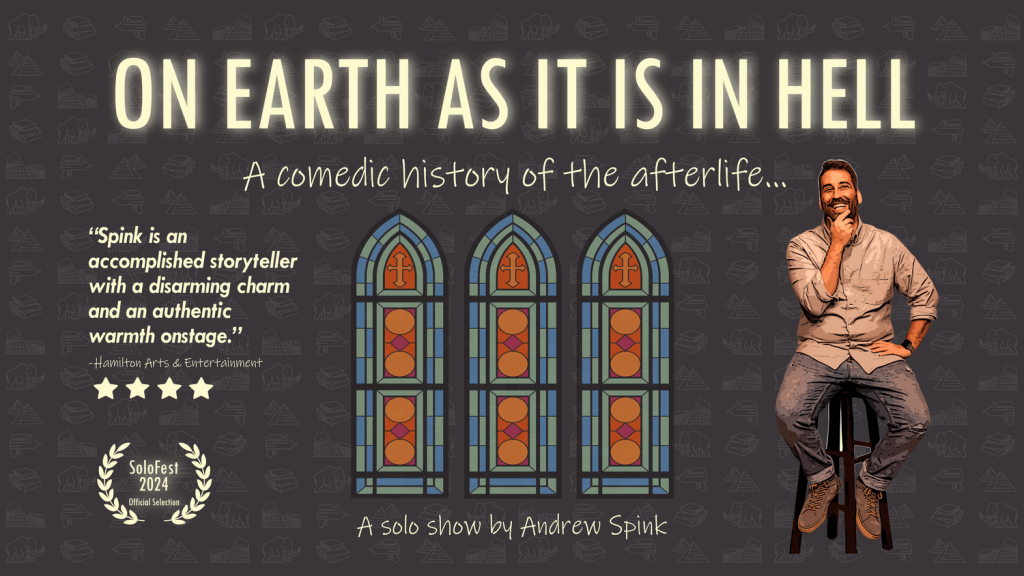
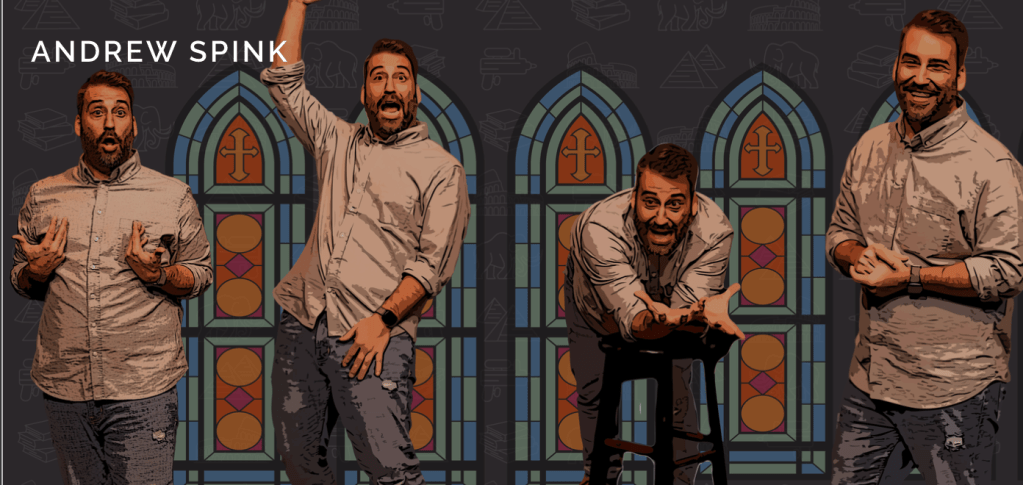
See new comedy show with speaker coach Andrew Spink, June 5th
If you’ve loved the talks on our stage, our speaker coaching system is a major reason why. One of our fantastic speaker coaches, Andrew Spink, is performing next week on Thursday June 5th and you don’t want to miss it. If you love storytelling you need to go.
It’s called On Earth As It Is In Hell. This comedic, true-life story, is about Andrew’s young daughter and how she is afraid of going to hell. This brings Andrew’s worst fears to life.
He grew up afraid of Hell, preached about Hell, and left Christianity over Hell. And now, Andrew was struggling to help his daughter feel safe. In mostly funny ways he shares how he learned just what the hell it is we believe anyway, and how our actions are often scarier than our beliefs.
When: Thursday June 5th, 7pm (doors open at 6pm)
Where: Here-after theater (inside the Crocodile on 1st ave, Belltown)
Tickets: $24.59 on sale now
He’s been on tour in Boston, Chicago, Denver, Atlanta and NYC and this is his one show here at home. Don’t miss it!
Ignite Seattle #48 Livestream
The best speaking tips from Ignite Seattle
We love helping our speakers tell great stories, but part of our mission is to help you do it too, whether it’s for speaking at work or for fun with your friends.
I’m Scott Berkun, former emcee, 7-time Ignite Seattle speaker and head coach for Ignite Seattle. Before I joined the Ignite Seattle team I wrote a popular book of public speaking advice. Since then I’ve learned even more from coaching hundreds of speakers for Ignite and many other events. Here’s my simplest and best advice for you.
1. You must set clear stakes
A good story has something at stake, or at risk, for the main character (typically that’s you!). As a speaker it is your job to establish the stakes for your audience. Why should they care? In our talk submissions, we’re hoping for talk titles that make the stakes clear in just one sentence. There is a big difference in stakes between a story titled “I went to Pike Place Market” and one called “How the gum wall nearly killed me.” The former is a fact, the latter is a story. Which talk would you rather hear?
Boring stories are just a series of events. “I went here, I did this, then I went there, blah blah blah.” Even if those are amazing places or achievements, they don’t mean much without stakes. Alternatively, a good story makes you care about what’s happening. You feel personally invested. Good storytellers achieve this by working hard to think about the stakes and making them interesting to the audience.
Stakes can be simple but they must be powerful. Everyone has been in love, or has had their heart broken. Everyone has a wish, or a fear, or a secret they’ve never told anyone. We coach our speakers to think about the biggest feelings in their story. What was the moment they were most afraid? Excited? Sad? Shocked? That’s where to slow the story down and tell us about that feeling. Stakes are more emotional than logical, which means a great story can be about an ordinary daily experience if the stakes are high enough.
Stakes can also be surprising. We love talks that surprise us by making us interested in topics or situations we would never have found interesting if not for the way the speaker has told the story.
Good examples from our stage include Why I Wish I Met My Mom’s Gynecologist and Why The Abacus Still Adds Up.

2. Overcome fear the smart way
Most advice on speaking fear is terrible. Please do not listen to it. Do not imagine the audience naked or practice in front of a mirror. Instead we teach people a simple fact: when you feel nervous your body is simply giving you energy to do a good job. It means you are doing something you care about, which is good. What you do with that energy is up to you and that’s what we coach speakers to focus on.
The truth is all performers feel nervous energy before they perform. This is true for star athletes and rock stars too. The reason is our brains evolved to worry when standing alone in front of many other creatures. Eons ago, before civilization and polite manners, standing alone usually meant you were about to get eaten. Our brains simply do not understand theaters, stadiums or classrooms, at least not yet. Instead of nervous energy, call it performance energy. Your body wants you to perform well. Isn’t that nice?
In other words, you overcome speaking fear by framing what you’re feeling in a better way. Being nervous is not a sign you are a bad speaker. Or that your story isn’t good. It’s just your brain doing it’s job keeping you alive. So embrace your body. Use that energy to practice more, or to make sure you get to wherever you are speaking early so your body can learn to feel safe in that space.
[You can watch my live talk about overcoming speaking fears and yes I felt nervous while doing it – in part because this room at Google’s HQ was right next to a noisy cafeteria at lunchtime! Extra challenging!]

3. Have beats and a rhythm
Since Ignite talks are only five minutes long it’s natural that we treat every second as precious. But everyone should care about time. Why? Attention spans are short! And it’s rhythm that makes it easy for for people to pay attention. In all music it’s the beat that helps you anticipate and trust what comes next. And storytelling is as much about rhythm as it is about melody.
A beat means a major event in the story. Every good story has a series of clear beats. We coach speakers to have one beat per minute as a rough guide. The first beat is typically for setting the stakes. If they establish the stakes later… it’s too late! More than a minute usually means they’ve spent too much time setting up the story and not enough telling it. Good storytellers get to the heart of the story quickly which takes effort. You have to be willing to edit and cut things down to the bone.
Two good examples of pacing include How to Dodge a Cringy First Date Disaster by Alisa Eddy, and Fix Evy-Thing by Evy Haroldson.

4. Make the world seem interesting
One common shortcoming in everyday storytelling is people who think they have an interesting story, but haven’t yet filtered out all of the not very interesting parts. Good storytellers do the hard work for the listeners. They eliminate all of the unnecessary details and facts and provide a compelling way to see what happened. Or they make profound choices that are irresistibly interesting.
For example, Linnea Westerlind visited every single public park in Seattle. She told us she wanted to do a talk about the experience and what she learned. It was easy to accept it because she had already done something unusual and interesting. Her story had naturally high stakes: who makes a commitment like this (it took years)? What motivated her? What did she learn? You can watch her talk here.
Similar talks in this style include Cut My Life Into Pizzas by Tricia Aung and How Death Becomes Us by Nicole Van Borkulo.
5. Practice is your friend
I’ve coached hundreds of speakers, and given hundreds of talks, and I promise you no one tells a good story without doing the work. It’s the people who do the work that typically do the best on any stage. Half the effort is thinking about the story (setting clear stakes and thinking about beats). The other half is in refining the performance of the talk through practice.
We strongly encourage speakers to talk their way through their material. To start practicing a rough version of it right away. At coaching sessions we have speakers improvise their story for two minutes and see what happens. We give them feedback on what to keep and what to reduce and have them do it again. And again. it’s this process of practicing and refining that has led to many of the best talks you’ve seen on our stage.
Some speakers prefer planning and writing first, which is OK. The danger is the trap of rehearsing and memorizing. You are not doing Shakespeare where the audience knows all the lines. You are also not a trained actor. This means that rehearsing and memorizing will likely make you sound more like a robot and less like yourself. You’re trying to be perfect for no good reason.
No one in the audience wants perfection. What they do want is to hear a good, thoughtful story from an interesting person. That’s it. Even worse, trying to be perfect makes most people more nervous, not less. Instead be OK with saying things a little differently each time. Be OK with taking some breaths, and some pauses, like a normal human being does. It’s OK to make little mistakes or to repeat parts. Even the best speakers do this sometimes. If you want to obsess, focus on having quality stakes and beats. If you get those right you’ll do well and you’ll sound less like a robot and more like yourself.
Learn by example: come to our next show
You can find me at our next event this month. Come up and say Hi! I’ll even answer your public speaking questions if I’m not too busy helping speakers prepare.
- Thursday May 22nd, at Town Hall Seattle
- Doors open at 6:30pm. Get there early for a pre-show activity
- Show starts at 7:30pm
- Show will end around 9:30pm, followed by an after-party
Get your tickets here. Hope to see you.
Announcing the Speakers and Talks for Ignite #48: May 22, 2025!
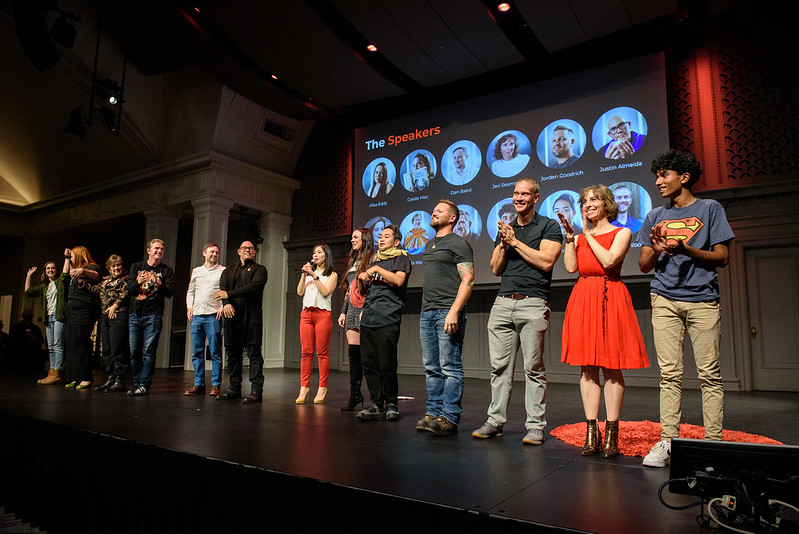
It’s here! We’re so excited to announce our speakers and talks for Ignite Seattle #48, just around the corner on May 22nd! Don’t miss this incredible line-up, buy your tickets now!
Here’s what’s sparking on stage:
- One Leg In, One Leg Out: Life as the 21st of 31 Children – Celine Anelone Brozovich
- I Ran a Hotel at 18 With No Idea What I Was Doing… Until a Wild Plant Saved Everything – Jon Cardenas
- Computer Keyboards Shouldn’t Be 5 Feet Wide – Matthew Dockrey
- The Heroes We’re Looking For – College Sophomores – Sarah Schacht
- My First Film Unexpectedly Fueled a Movement – Rob Young
- Me So Phony Uh – Ten to Twenty Percent of Us Will Hate This – Justin Resnick
- My Life’s a Supply Chain —and Sometimes Everything’s on Backorder – Chelsea Wright
- She Won Millions. That’s When Everything Fell Apart. – Justin M. Riordan
- Who Adopted Who? – Molly Hawkins
- What Viagra Taught Me About Peak Performance – Lei Wang
- I Left My Brain in Iraq – Melissa Margain
- So You Think You Want To Rave (And You’re Over 50!) – Noah Edelstein
Join us at Town Hall Seattle on May 22nd. Doors open at 6:30 for pre-show activities and social experiments, and the show starts at 7:30.
We expect to sell out, so:
Learn Public Speaking: Free workshop in April
Do you want to learn how to speak and tell stories as well as the people you’ve seen on our stage? This is your chance! Our next free workshop is on Thursday April 3rd on Zoom. It’s FREE and open to everyone.
Also: our next main event is Thurs. May 22nd and you can buy early bird tickets here.
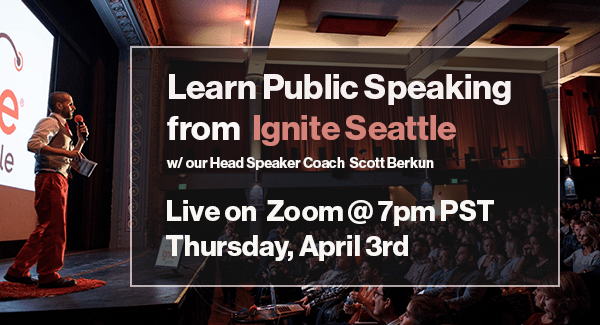
What: Learn Public Speaking from Ignite Seattle
This free event will take place Thursday April 3rd, at 7pm PST on Zoom. Register for this workshop here.
Here’s what to expect:
1. Get our best lessons quickly. Our head speaker coach, and bestselling author, Scott Berkun, has coached hundreds of speakers. You’ll get his best and most effective lessons for how to be a better public speaker and storyteller. And you can learn more about Ignite Seattle and how to submit talk ideas.
2. Learn fast and have fun. If you’ve been to our events at Town Hall, you know how much we care about making sure you have a good time. This session is no different! You’ll get a short talk identifying the common mistakes people make and advice on how to improve. And then there will be an open workshop where you can get live feedback on your own story or presentation.
3. Who is your teacher? Berkun is a bestselling author and popular speaker on creativity, innovation, culture, and many other subjects. He is the founding speaker coach for Ignite Seattle and a former MC for the event. He’s one of the most experienced coaches in the Seattle area, and gives dozens of presentations annually in the U.S. and around the world, so he practices what he preaches.
When/Where:
- Thursday, April 3rd, 7pm PST
- Live on Zoom
This session promises to be:
- Practical and focused on common situations
- Fast-paced, fun and funny
- Based on Berkun’s bestselling book, Confessions Of A Public Speaker
- Interactive – with time for Q&A and for you to get feedback on a story or presentation
Who should attend?
- People with little to intermediate speaking experience
- Folks with a sense of humor and like to have fun
- Bring your questions – this is interactive!
47 Game-Changing Lessons from Ignite Seattle #47
Thanks to all 900+ folks who joined us at Town Hall last week for Ignite Seattle #47.
One of our featured speakers wrote about her experience at the event. Alysse Bryson. podcaster and media maven, gave a talk titled Sip Happens: Connection Without Alcohol, exploring how the real goals we have transcend what we’re drinking or not drinking.
Here’s what she had to say about her experience at Ignite Seattle:
Ignite Seattle isn’t just another public speaking event—it’s a phenomenon that transforms the ordinary into the extraordinary. Picture this: the historic Town Hall in Seattle, thrumming with the energy of nearly 900 curious souls IRL and another several hundred online watching the live-stream….
This isn’t your standard corporate PowerPoint snooze-fest. At Ignite Seattle, every speaker is given 20 slides that flip every 15 seconds, challenging them to distill their passion, humor, and insight into a potent burst of narrative magic. “Enlighten us… but make it quick” isn’t just a tagline—it’s a call to arms for anyone brave enough to share their story.
She also shared 47 great things she learned. Here are the first 7:
- I can do hard things.
- Ignite Seattle is one of the coolest nonprofit organizations I’ve had the honor to be a part of.
- 5 Minutes goes really fast.
- 900+ people is A LOT OF PEOPLE.
- Practice does not make perfect.
- Perfection isn’t necessary.
- The Ignite Seattle audience is one of the sweetest and most supportive audiences you could perform in front of.
Read the rest of her inspiring list here Or watch her talk below:
 Ignite Seattle