
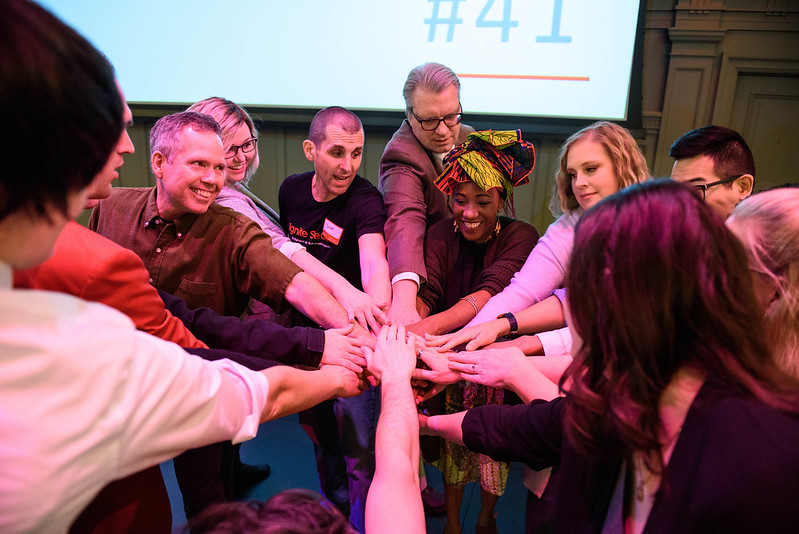
In 2010 I started the speaker coaching program here at Ignite Seattle. Before I joined the team, I was a speaker many times, including an Ignite talk on how to give good Ignite talks. I know first hand how challenging public speaking can be, especially in our format, which requires slides that auto-advance. We do this to keep our talks exciting and fast paced, but it does add some extra challenges.
We’ve now coached hundreds of speakers for our event, many with little public speaking experience. And since our mission is to help everyone become better speakers I’ll be sharing more of our lessons with you here.
This post is a behind the scenes view of what our coaches, myself, Beth Jusino and Andrew Spink, and our entire organizing team, do for our speakers.
Design the audience experience
To help our speakers before they get on stage, we want an audience that feels like they are already part of something fun. We think of the event as a show, where the MC, the organizing team and each of the speakers have a role to play. We have pre-show activities in the lobby, so when guests arrive they can get a drink and do something fun related to the show, or just chill out and observe.
We have intermissions that make it easy to talk to people if that’s your thing, or take a break and have a snack. We try to keep the experience going all the way through to the last call at our after-party (open to all attendees). We do everything we can to create an environment where it’s easy to relax, learn, grow and experience what our speakers have chosen to share.


Speakers are the stars
From the moment we send out acceptance emails to speakers, our entire team is committed to treating speakers like stars. We see them as the talent, and our role is to be their support team. We know that if we take the event seriously, speakers will put in the work and do a great job on our stage.
All speakers are encouraged to participate in three levels of training before the show:
- Speaker coaching workshop: we developed a fun format that focuses on learning skills through practice. We also share a meal together so speakers get to know the organizing team they’ll spend time with in the weeks leading up to the event.
- Individual coaching: Speakers are paired with coaches who give them customized feedback on Zoom or in person.
- Final rehearsal: we get together in-person a second time to see near-final talks and plan the speaking order for the show.
We typically get 50 submissions for each event and only have 12 or fewer speaking slots. This means we turn away dozens of people who want to participate (you can submit your talk idea here). We sometimes do smaller open-mic events in between shows to give more people a chance to share their story to a supportive audience.


The stage is your home
We know from neuroscience that fear of speaking comes from unfamiliarity. At the beginning of speaker coaching we walk speakers through what the event will actually be like: where they will sit, how they will come on stage and what the stage itself looks like from the speaker’s perspective.

We want speakers to arrive feeling like they’ve been there before. We always have a confidence monitor (a screen showing what is on the projector behind them) on stage so they can focus on their delivery and not worry if the screen behind them is working or not.
We also invite speakers to come to our venue, Town Hall Seattle, hours before the event starts. We don’t want them fighting through traffic or worrying about being late. Instead we want them relaxed, safe, fed and feeling like they are at home with the organizing team.


Know your stakes
We believe in the classic storytelling advice to identify the stakes of your story. Stakes are defined as the risks or rewards for the main character. For educational talks, the main character is the audience and how they can learn or grow. Establishing the stakes with the audience early creates anticipation, tension and interest. It’s stakes that invite the audience to care about a story and what is going to happen next.
This is why our submission form is so short. If you can’t explain the stakes of your story in just 100 words, it’s a sign you’re not going to be able to do it in 5 minutes on stage either.
Here are titles of past talks with clear stakes, which make it easier to build a good talk:
- I’m the Weirdo Who Left the Elevator Note
- How to Lose Yourself in a Labyrinth
- Dating Via Your Dad and an Ad
- You Can’t Ask a Choking Man for Instructions
We encourage speakers to watch Ignite Seattle talks from our archive. They are only 5 minutes long! You can easily watch ten in an hour and get your own sense for what works well or doesn’t.
Your first minute matters
Everyone hates people who start telling a story but never get to the point. This is the opposite of what we coach for. We know most people, most of the time, can get to the point faster than they do. A TV commercial is 30 seconds long. TikTok videos and Instagram Reels are even shorter.
For our speakers, we coach them to get to the heart of their talk around the first minute mark. That gives them 80% to tell the most interesting version of their story, or answer the question asked in their title.
How do we achieve this? Editing, feedback and practice! In our group sessions and one-on-one coaching, we ask speakers to practice and explore, figuring out what is most important to say and what can be cut.
Craft your story first, slides later
We tell our speakers that if somehow we had to choose between having enough power for their microphone or the PowerPoint slides, we’d always pick the microphone. Why? Slides are props. What matters most is the person, their voice and their story.
We strongly recommend speakers work on just giving a great talk in five minutes first and work without any slides for awhile. This is the easiest way to neutralize the challenges of auto-advancing slides. When your talk is mostly figured out, you can just have slides that are images related to your theme, but open to interpretation, allowing your talk to work even if your timing isn’t perfect every time.

Trust our MC
Ignite Seattle has one of the most vocal and supportive audiences anywhere. We’ve been training our audience for years that they are lucky to get to sit back and watch, instead of having to get up on stage. Our MC plays a key role in reminding the audience of this every show.
The MC opens the show, gets the audience energy level up, introduces the speakers (so they always start with a round of applause) and takes care of any surprises or last minute housekeeping. The MC is on stage more than anyone else and they play a key role in Ignite Seattle culture (including often wearing the traditional red pants).
Our MC is always part of the team at speaker coaching and rehearsal, even if they are a guest MC.


Now we want you to do something
You’ve learned more about how we coach our speakers. Here’s how you can get involved:
- Submit a talk. We provide great advice on how to pitch us.
- Get tickets to our next event and bring your friends.
- Join our mailing list for announcements and public speaking workshops.








 Ignite Seattle